

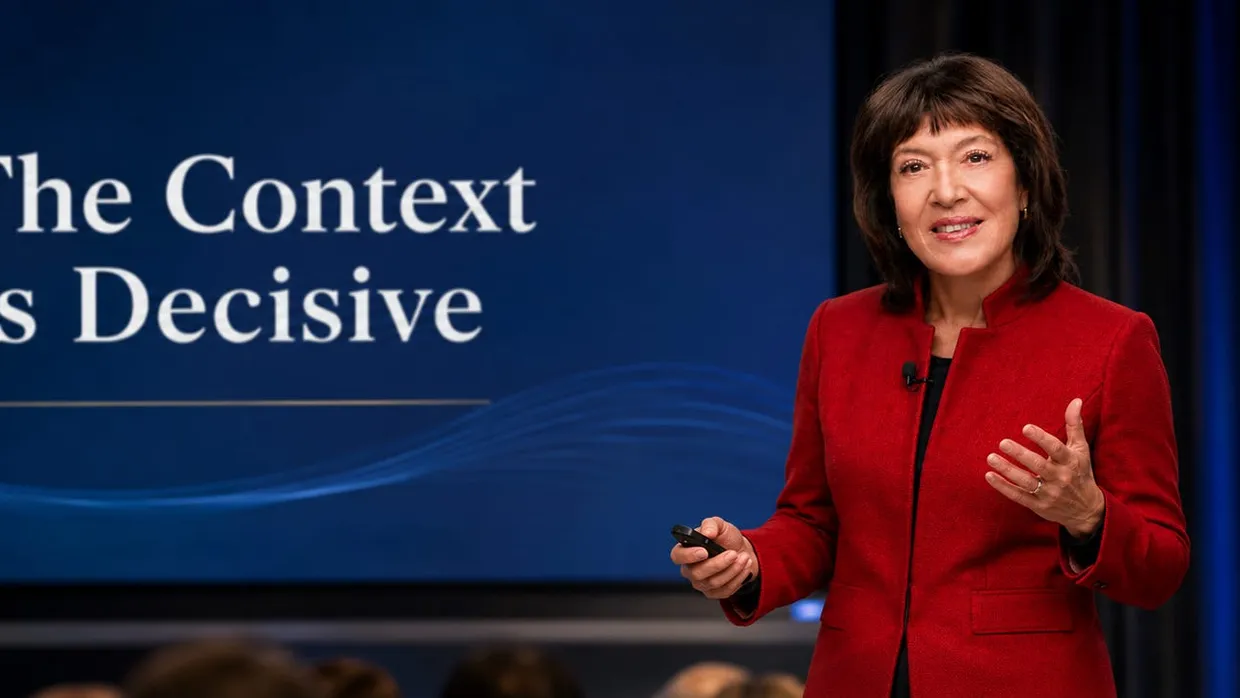
At a recent IOD AI Forum (New Zealand), a number was shared that has stayed with me.
New Zealand is the second most AI-nervous country surveyed. (In fact, our friends across the ditch, Australia, are number one.) Not unintelligent. Not anti-progress. Nervous.
That nervousness is being treated by many as a problem to fix. A confidence gap. An adoption issue. A communications challenge. Something to reassure people through so we can get on with the future.
I want to suggest something different.
What if the anxiety is not the problem? What if it is the signal?
People may be sensing something that has not yet been properly named. AI is moving faster than the human conditions required to use it well.
The tools are advancing quickly. The context they are landing in has not caught up.
And that is where the real leadership issue begins.
Environment, culture, context: three different things
We need to be precise here. Environment is not context. Culture is not context either. Both are easier to talk about. Neither is what actually shapes behaviour.
The environment is what surrounds people. It includes AI tools, economic pressure, hybrid work, regulation, talent shortages, market disruption, board scrutiny and constant change.
Culture is the network of conversations that exist inside the environment. It is what people say about themselves and each other, often unspoken.
Context is something else again. Context is what shapes how people behave when no one is watching.
Context is the behavioural field people are operating inside. It tells them what is safe to say, what must be hidden, who can challenge, who must soften the message, what gets rewarded, what gets punished, which promises matter, and which conversations can be delayed without consequence.
That is why two organisations can have the same AI tools, the same market pressure, the same policy templates and the same consultants, and produce completely different results.
The environment may be similar. The culture may look similar. The context is not.
- A tool enters an environment.
- The culture talks about it.
- The context decides what it becomes.
What context really is
Context is not the background to behaviour. Context is what makes behaviour make sense.
Inside organisations, it is made through conversations, agreements, power dynamics, cultural norms, trust, accountability, leadership behaviour and the things people learn they can get away with. Through what gets said in meetings, and what gets decided afterwards in the corridor. Through the promises people keep, and the promises everyone quietly stops mentioning. Through gossip, silence, avoidance, loyalty, fear, status, humour, resignation, and the small daily signals that tell people whether truth is welcome or dangerous.
For a board, context shows up in which questions are asked and which are politely avoided. For an executive team, it shows up in who owns the decision and who merely comments on it. For a manager, it shows up in whether accountability is lived or performed. For a founder, it shows up in the conversations you keep having in your own head, the decisions you keep postponing, and the agreements you made with yourself five years ago that no longer fit who you have become.
Behaviour does not happen in a vacuum. Behaviour happens inside context.
And when that context is left unexamined, AI does not transform the organisation. It accelerates the existing patterns.
The productivity paradox no one wants to name
We were told AI would save time. In some tasks, it does. Drafts arrive faster. Summaries appear in seconds. Proposals can be shaped in minutes. Meetings can be recorded, transcribed and reduced to action points before anyone has left the room.
And yet many of the leaders, owners and operators I sit with are more time-poor than they were two years ago.
The work is faster. The day is not lighter. The output has increased. The space has not appeared.
That is not because people are using AI badly. It is because AI is being introduced into operating systems that have not changed.
The same unclear roles. The same avoidance of hard conversations. The same weak delegation. The same meetings where everything is discussed and very little is decided. The same habit of producing more instead of stopping long enough to ask what is actually needed.
AI can make the artefacts of work faster. It cannot, by itself, restore integrity to the context the work is happening inside.
For the CEO, this shows up as a leadership team that produces more documents and makes fewer real decisions. For the board, it shows up as governance that looks tidy in the minutes and feels increasingly unmoored from the business it is meant to be steering. For the founder, it shows up as a business that is technically scaling and personally collapsing. These are not separate problems. They are the same problem appearing at different altitudes of the same organisation.
One phrase from the IOD AI Forum has stayed with me as much as the anxiety number. Speed without direction is just expensive chaos. The forum was right to name it. The harder question is where direction comes from. It does not come from the tool. It does not come from the strategy document, the AI policy or the risk register. It comes from the context underneath all of them. Which is exactly the thing most organisations have not stopped long enough to examine.
How context produces the Provenance Reflex
In a recent piece I named the Provenance Reflex. The habit of accepting fluent output before we have properly understood where it came from, what shaped it, and whether it deserves our trust.
It is not just an information problem. It is a context problem.
It appears when a context rewards speed, polish and completion more than depth, source awareness and judgement.
The AI produces an answer. The answer sounds coherent. The document looks finished. The meeting can move on. And because everyone is busy, pressured and trying not to look behind, the output is accepted before anyone has properly asked. Where did this come from. What has been left out. What assumptions are embedded here. What judgement is still required from us.
That behaviour does not come from AI alone. AI provides the fluent output. The context decides whether fluency is mistaken for truth.
If the organisation has trained people to value polished artefacts more than disciplined thinking, the Provenance Reflex will spread quickly. People will not necessarily mean to become careless. They will simply follow the context. They will accept what looks complete because the context has not required them to stay with the question long enough to know.
I sat recently with a senior leadership team who had implemented every major AI tool in the market. Their output had tripled in six months. Their decision velocity had halved.
Tripled output. Halved decisions. That is not productivity. That is expensive chaos with a dashboard.
How context produces Accountability Drift
The second pattern I have written about is Accountability Drift. The subtle movement of judgement away from the person who remains formally answerable.
This is also a context problem.
It happens when the tool moves closer to the decision, while the human remains formally responsible but less behaviourally present. That does not happen randomly. It happens in contexts where decision rights are unclear, challenge is weak, leaders are overloaded, and accountability has become more of a structure than a lived behaviour.
The AI recommends. The human accepts. The board paper includes it. The team acts.
Everyone can point to the process.
But the harder question remains. Who actually sat in the judgement of the decision. Who understood the trade-off. Who felt the consequence. Who remained in the seat.
If no one did, accountability has drifted.
AI did not create the pattern from nothing. It entered a context where the conditions for drift were already present. The tool simply made the drift easier, faster and harder to see.
What is left to name
So, we have named the patterns. The Provenance Reflex. Accountability Drift. Both produced by context. Both quietly costing more than the dashboards will admit.
But naming the patterns is not enough.
There is a layer inside every organisation where context is actually made. It is not in the strategy document. It is not in the policy. It is in the conversations, the agreements (verbal and unspoken) and the silences between them. AI cannot reach it. Most leaders never read it.
The ones who do, change everything.
There is also a third pattern that lives in this layer. The one that decides what every AI tool in your organisation actually becomes. I will name it in Part 2.
Part 2 of The Context Is Decisive publishes today. To make sure you receive it, subscribe.
Source. Ipsos AI Monitor 2025, a 31-country study released October 2025. Australia ranked highest at 67 percent nervous. New Zealand ranked second at 66 percent. The global average is 52 percent.
This is Part 1 of the final piece in a series on the leadership patterns shaping the AI era. The first, Provenance Is Not the Point, examined the habit of accepting fluent AI output before understanding where it came from. The second, Who Is Actually Flying, named the pattern of Accountability Drift. This piece, in two parts, names the conditions that produce both, and the third pattern that lives there.
