

Last week’s piece on the Provenance Reflex prompted many DMs, most asking the same thing. What are the behaviours underneath the pattern, and how do we interrupt them. Thank you. It is always an honour when people respond.
One response you may want to read is Stephen Morison’s piece on what the Provenance Reflex now means for SMEs across Australia and New Zealand
What follows answers the DMs. And names the next pattern.
Naughty, naughty.
That is the first thing I want to say to some of the boardrooms, executive teams and business owners I have been sitting with over the past year.
To the director who quietly used Copilot to summarise the board pack and arrived feeling prepared. To the CEO who asked an AI for the strategic answer and then presented the output as their own thinking. To the partner whose report was drafted in the cloud and never properly read by the person whose name appeared on it. To the founder who fed a difficult decision into ChatGPT, felt the relief of something fluent coming back, and mistook that relief for clarity.
Naughty, naughty.
I say that with mischief, not moral superiority. Because if I am honest, I have done it too. And, you probably have as well. That is the point. We are neurologically wired for comfort, and AI is the most efficient comfort-built machine humans have ever built. AI is simply not making people more productive, it is changing the conditions under which judgement is exercised, decisions are made and accountability is earned.
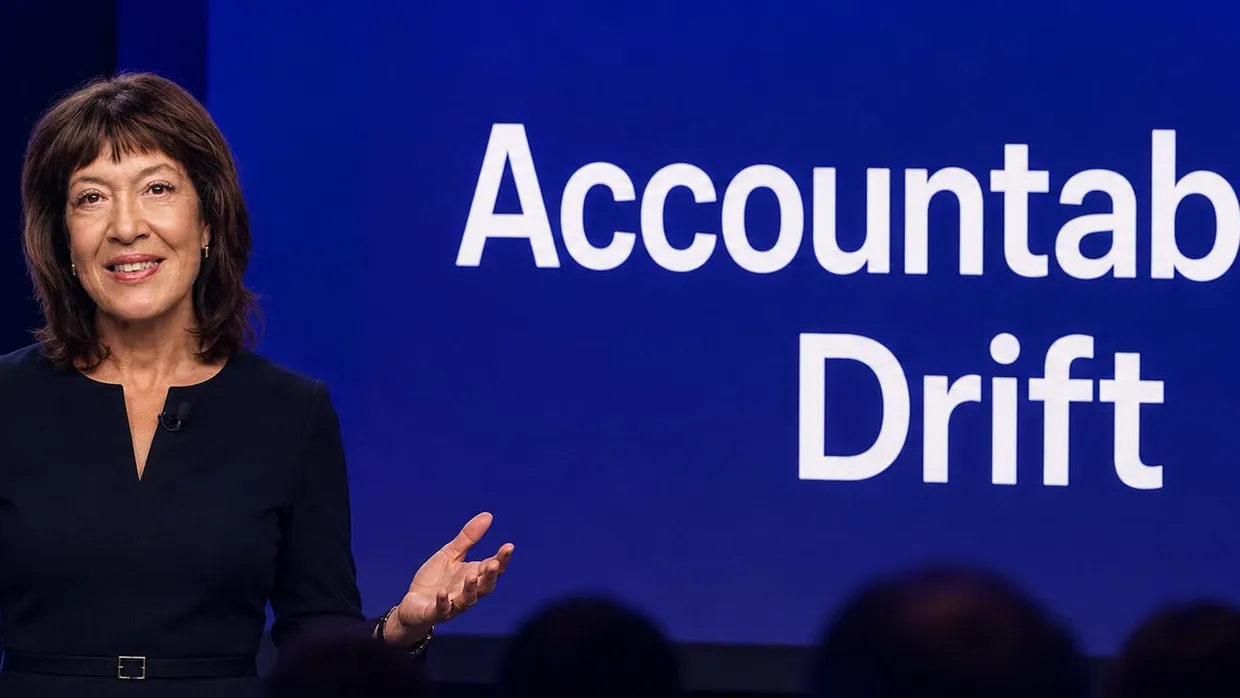
That pattern needs a name. I am calling it “Accountability Drift”.
The policy was there.
Closer to home, the New Zealand Department of Corrections had to step in earlier this year after staff were found using Microsoft Copilot in ways that breached internal handling rules for sensitive information. This is what makes the example important. Corrections were not operating in a vacuum.
There was policy. There was guidance. There was training. There was governance. There were reminders. There was a stated boundary around sensitive personal information. And still, the slippage happened. This is not a Corrections problem. It is a human problem.
A policy is a document. A reflex is a behaviour. Documents do not interrupt behaviours. They may describe the behaviour we want. They may record the behaviour we expect. They may even create consequences when the wrong behaviour is found.
But they do not, by themselves, interrupt the moment when a tired person under pressure sees an easier path and takes it. That moment is where the real governance problem lives. Not in the policy folder. Not in the AI strategy. Not in the training attendance record. In the human nervous system, at the point of decision.
That is why this conversation has to move from policy to pattern.
From policy to pattern
AI is not only exposing gaps in policy. It is exposing behavioural reflexes that were already there: avoidance, over-reliance, false confidence, deference to fluency, discomfort bypassing, decision drift. Until those patterns are named, they remain invisible. What remains invisible cannot be interrupted.
This is the work of Pattern Intelligence™.
Not naming emotions, but naming the patterns that shape behaviour, judgement, trust and decision-making before they harden into the way an organisation operates. The first pattern I named was the “Provenance Reflex”: the assumption that knowing where information came from is the same as engaging with what it says.
That pattern still matters. But the next layer is deeper. It is not only about whether we know AI was used. It is about whether the accountable person remained present enough to think.
The next layer: Accountability Drift
Accountability Drift is the gradual relocation of judgement away from the person, role, or body that remains formally answerable for the consequence of a decision. The seat is still occupied. The title is still there. The authority is still there. The signature is still there. The salary is still there. The meeting still happens. The minutes still record the decision. But the judgement has quietly moved. Not vanished dramatically.
Drifted.
A little less reading. A little less wrestling. A little less independent thought. A little more summary. A little more fluency. A little more reliance on something that sounds coherent. A little more comfort. That is why the pattern is so dangerous.
It does not feel like a failure. It feels like relief. It feels like efficiency. It feels like being prepared. It feels like keeping up. And sometimes it is. But sometimes the seat has begun to empty while everyone is still behaving as though it is occupied.
Responsibility can move. Accountability cannot.
Responsibility is the work: the reading, drafting, checking, summarising, modelling, comparing, researching, preparing and reporting. Responsibility can be shared. It can be delegated. It can be automated. It can be supported by AI.
Accountability is different.
Accountability is the discipline of remaining present with the discomfort the role contains. That discomfort is not an unfortunate side effect of leadership. It is part of the role. You are not paid significantly because every task is difficult. You are paid because when the consequences arrive, the answering cannot be delegated. That is true for directors, CEOs, founders, senior managers, and team leads making decisions that affect people, customers, money, safety, and trust.
Responsibility scales. Accountability does not.
Many people can contribute to the work. Only one person, or one clearly constituted body, can finally answer for the decision. That is the line AI is beginning to blur.
Accountability is no longer inherited.
For a long time, organisations assumed accountability would be absorbed.
You stepped into bigger roles. You watched senior people. You made mistakes. You carried consequences. You learned how to sit in discomfort because the role kept putting you there. The conditions trained you. That assumption no longer holds.
AI has changed the training environment. It removes the friction that once forced people to practise judgement. It drafts the difficult sentence. It summarises the heavy paper. It produces the argument. It provides the language. It offers a version of certainty when the honest human experience is uncertainty.
Accountability for emerging leaders?
For senior people who developed their judgement before AI, the danger is de-conditioning. The muscle was built, but it can soften. We must not let it. We are role modelling.
For emerging leaders, the danger is different. They may enter management and decision-making in an environment where the substitute is always available before the muscle has fully formed. That is not a criticism of younger talent. It is a design problem. If the environment no longer reliably produces accountability, then accountability must be deliberately taught.
Put simply, we can no longer assume people develop accountability just by moving into bigger roles. It must be taught, practised, observed, and reinforced.
This is the shift:
Accountability is now a learned behavioural technology, not an inherited professional norm. Otherwise, organisations will keep assuming people have developed a discipline the working environment no longer requires them to develop. That assumption will become expensive.
The boardroom version
In the boardroom, Accountability Drift rarely looks reckless. It looks tidy.
The papers are ready. The AI disclosure is included. The dashboard is tidy. Management’s recommendation is clear. The board pack has been summarised. The meeting runs efficiently. The minutes capture the decision.
Everyone leaves feeling the work is done. But what actually happened?
Did directors engage with the substance or just the summary?
Did they challenge the assumptions or simply accept the presentation?
Did they test the AI-derived analysis or merely note its use?
Did they apply independent judgement or rely on management’s confidence?
Did they ask what had been rejected, or focus only on what was recommended?
Did they sit with the discomfort of uncertainty, or accept the first version that let the meeting move on?
Minutes record outcomes. They rarely capture thinking.
Policies record intent. They rarely interrupt drift. Disclosures record AI use.
None of that proves engagement. For boards, the question is no longer, “Do we have an AI policy?” It is, “Can we show that judgement was exercised?”
The SME version
In SMEs, Accountability Drift is harder to spot because it often looks like survival.
The same person prompts the tool, accepts the output, sends the proposal, signs the contract, hires the person, changes the price, and carries the consequences. Often with no buffer. AI can be a legitimate force multiplier here.
It can keep the business moving and help the owner compete with larger players.
But if it quietly replaces verification, judgement, or difficult conversations, the cost shows up quickly. Cashflow errors. Fractured customer trust. People issues that compound. Contracts signed on the strength of a summary. Pricing decisions that look rational but weaken the business. Decisions that feel “done” but were never fully owned.
SMEs do not need governance theatre. They need a lightweight accountability discipline that protects people, trust, and business value.
The Captain Test
A simple test helps. Think about an aircraft: the captain is accountable for the flight.
The co-pilot, cabin crew, ground engineers, and air traffic control each carry responsibility for getting the aircraft from one place to another. The captain delegates constantly but never delegates the answering.
If the aircraft goes down, no one walks into the inquiry and says, “The autopilot was flying.” Notice what the tools were called.
Copilots, not captains. The branding was honest.
The risk is that many people in the captain’s seat are starting to use the copilot as though it were the captain. So here is the test.
Can this work be shared, delegated, automated, or supported by more than one person or system? If yes, you are probably looking at responsibility. Can the final answering for the consequence be shared in the same way? If not, you are looking at accountability.
The test shows you where responsibility has moved. It also shows you where accountability must not drift.
The material decision record
Not every AI-touched action needs a governance ceremony. (Dependant on the enterprise).
Please, no. That would be policy theatre in a high-vis vest. For decisions that matter, keep a short record:
Where did AI help?
What did the human test, reject, or question?
What was finally decided, and why?
That is enough.
Not paperwork.
Proof that thinking happened.
I am not interested in shaming people for using AI to cope. I use it too. We are all trying to keep up with the velocity of this era.
But if we want people, trust, and business value to flourish, we have to protect the conditions where judgement is still trained, not quietly outsourced. Especially when the tool makes bypassing discomfort feel efficient.
So, the question is no longer, “Are you using AI?” Of course you are. The question is not even, “Do you have a policy?” You probably do or soon will.
The harder question is this:
Where in your organisation has judgement quietly moved away from the person who is still expected to carry the consequence?
That is Accountability Drift. And once you can see it, you can interrupt it.
The aircraft is already in the air. The copilot is already on board.
The real test now is not whether AI can assist the flight. It is whether, at every level of the organisation, people are still being trained to fly.
Because when the moment comes, the organisation will not ask the copilot to explain the decision.
It will ask the human.
Note:
This piece names the pattern. The work that follows is interrupting it.
In August and September, we are launching Peak to Peak Performance for the AI Era. A human operating system upgrade for leaders at every level, and for SME owners carrying the whole business in their own seat.
It is built on Pattern Intelligence™ and CatalyzeAPAC Decision Thinking, with lessons drawn from elite performance organisations including Emirates Team New Zealand, Australian Cricket, Chicago Bulls, and Williams F1. The result is a unique lens that reveals how you actually operate when the pressure is on.
AI will not fix the patterns underneath your performance. It will amplify them.
Reply or DM to be on the early access list.
Is Your Organisation Future Fit?
Primary source:
Sam Sherwood, Corrections takes action against staff’s ‘unacceptable’ use of artificial intelligence, RNZ, 16 February 2026.
https://www.rnz.co.nz/news/national/586932/corrections-takes-action-against-staff-s-unacceptable-use-of-artificial-intelligence
